
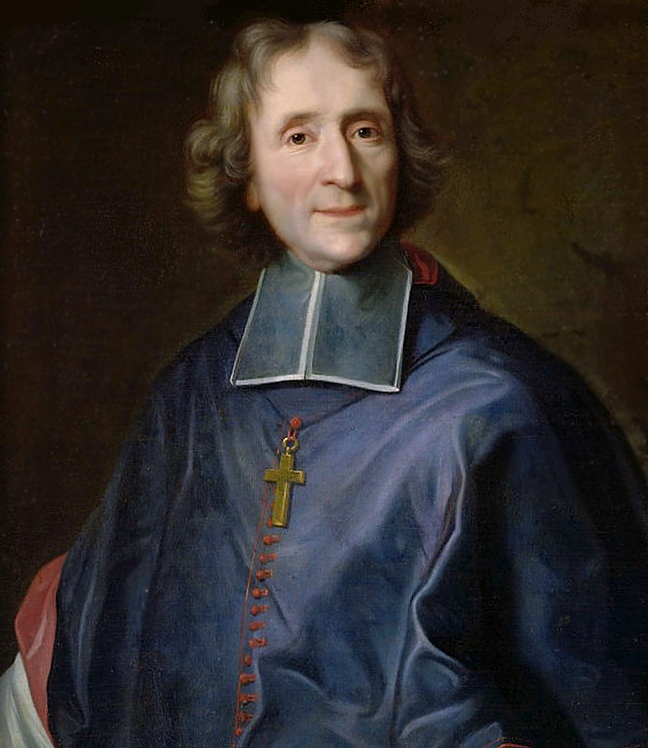
François de Salignac de la Mothe-Fénelon, or as he is more commonly known, François Fénelon, was a French Catholic archbishop, theologian, and philosopher who has been called “The Forgotten Philosopher” by some. But during the 18th century he was one of the most well-known philosophers in Europe and his book The Adventures of Telemachus was the most popular book in France during that century other than the Bible.
Unfortunately, Fénelon’s writings on economics, politics, and theology have largely been forgotten as only a fraction of his work has been translated into English. But he was a favorite among the likes of Montesquieu, Rousseau and even Thomas Jefferson.
And he was such a renowned educator that he was hired by the king of France as a tutor to the future heir.
He was a profound and revolutionary thinker across many domains including education, politics, the separation of church and state, the benefits of free commerce between nations, and was even involved in the hottest spiritual and theological debate of the time, the quietest controversy over the doctrine of pure love.
In fact, he is credited with formulating the most theologically sound defense of quietism at the time.
Unfortunately, in 1699 his revolutionary ideas managed to anger both the king and the pope resulting in censorship and his banishment from Versailles. Nevertheless, even with all the authority in the world turned against him, he remained steady in his convictions and his character and continued to act as spiritual advisor to many prominent individuals in both church and state.
His influence can still be felt today and there has been a recent resurgence in interest in his thought, but many of his works are still very difficult or impossible to find in English.
So, here I’m going to introduce you all to this incredible man with a brief biography and some selected quotations from his own writing so that you can get a sense of his thought from his own words because I think we can all benefit from engaging with him and his ideas.
His Early Life
Francois was born in 1651 at the Chateau de Fénelon which is where he gets his name. His family were established nobility and had long-standing deep connections to both Church and state. His uncle was currently serving as the bishop of nearby Sarlat, a position which had been filled by fifteen successive generations of Fénelon’s. He was intelligent and ambitious from a young age. He was trained by private tutors in Greek and Latin and studied philosophy and rhetoric at a Jesuit university. At a young age he expressed an interest in a career in the Church and his uncle arranged for him to study theology at a college in Paris where he showed so much talent that he was asked to give his first public sermon at only 15.
Around 1675 when he was 24 he was ordained a priest. And in 1685 the king revoked the Edict of Nantes, which was an attempt by King Henry the fourth to promote civil unity and end the long-running French wars of religion, and the Church began a campaign to send their best orators into the areas of France with the highest concentration of protestants, to persuade them of the errors of Protestantism and convert them to Catholicism, and François being the brilliant and eloquent orator that he was was selected and he served as a missionary preaching to the protestants for three years.
Promotion and Controversy
In 1688 he met his cousin who is known as Madame Guyon and is herself an influential Christian mystic. They both greatly influenced each other and she will feature prominently later in his life.
But in 1689 he was assigned as the tutor to the Duke of Burgundy who was second in line to the throne. As such he was responsible for shaping the character of a future king of France and his work during this time reflects this. His writing during this time is very political and this is when he wrote The Adventures of Telemachus that I mentioned earlier which was an instant success and influenced generations of French kings and philosophers and even some of our own Founding Fathers. Thomas Jefferson apparently re-read it frequently, and the French literary historian Jean-Claude Bonnet called it “the true key to the museum of the eighteenth-century imagination”. One critic described it this way:
“Fénelon’s story stood as a powerful rebuke to the aristocratic court culture that dominated European societies, with its perceived artificiality, hypocrisy, and monumental selfishness. The book did not simply express these feelings; it helped shape and popularize them.”
In 1696 he became archbishop of Cambrai while remaining in his position as tutor to the Duke of Burgundy at the request of the king. But his relationship with the king would sour rather quickly. For some years controversy had followed his cousin and close friend Madame Guyon because her teachings resembled the quietism of Miguel de Molinos which had been officially condemned by the pope. A commission was formed to review her teaching and after months of deliberation articles were drafted and a few certain opinions of hers were condemned even though the commission did provide her with a certificate as to the excellence of her conduct. However, when there were moves to further condemn her Fénelon objected stating:
“I have often seen Madame Guyon. Everyone knows that I have been intimately acquainted with her. I may say, further, that I have esteemed her, and that I have suffered her also to be esteemed by illustrious persons, whose reputation is dear to the Church, and who had confidence in me…. Let others, who are acquainted with her writings only, explain the meanings of those writings and censure them. But, as for myself, I think I am in justice bound to judge the meaning of her writings from her real opinions, with which I am thoroughly acquainted; and not of her opinions by the harsh interpretations which are given to her expressions, and which she never intended.”
It seems that the objections to Madame Guyon’s writings were not based on what she actually said and meant or on her own personal character. A theme that would repeat itself with Fenelon. In fact, it was out of this conflict that his masterpiece the Maxims of the Mystics would arise, which he wrote as a defense of Madame Guyon’s brand of mysticism. This resulted in a feud between Fenelon and Bossuet the Bishop of Meaux which would last for years and turn very bitter, at least for Bossuet. Fénelon’s responses are a great example of the strength of his character even when under vicious personal attack. For the bishop would eventually abandon rational argument and resort to slander. He had in his possession confidential letters from Fénelon and Madame Guyon and wrote a scandalous story called The History of Quietism in which he implied that their relationship wasn’t as virtuous as they claimed. Fenelon was eventually compelled to respond and stated:
“The secret of private letters, written in intimate and religious confidence (the most sacred after that of confession), has nothing sacred, nothing inviolable to him. He prints letters which I wrote to him in the strictest confidence. But all will be useless to him. He will find that nothing that is dishonorable ever proves serviceable. I pray God to bestow upon the Bishop of Meaux as many blessings as the Bishop of Meaux has inflicted crosses upon me.”
And it seemed for a while that Fénelon had the advantage and the matter was over, until King Louis the fourteenth got involved. He wrote to the pope asking him to formally condemn Fenelon and the pope reluctantly conceded. The first two commissions formed to review him failed to come to any conclusion, so a third was appointed consisting entirely of cardinals and they met over a hundred times. They found that it was impossible to condemn his doctrines absolutely, least of all as taught by a person of the spiritual eminence of Fénelon. However, they did find that certain propositions in the Maxims were deserving of censure.
But the king was so angered by the opinions expressed in the Maxims that he had Fénelon removed as tutor to the duke and ordered him to remain within the boundaries of his archdiocese. And he refused to let the matter go. He wrote again to the pope and demanded a clear pronouncement against the book. And in 1699 the inquisition officially condemned 23 propositions from the Maxims of the Mystics but the pope was careful to protect both himself and Fénelon. It was stated that these propositions were not condemned in themselves, nor as they were understood and explained by Fénelon, but as they might be, and actually were, understood and explained by others. Fénelon quietly accepted and even preached a sermon on the duty of obedience.
However, that same year his book The Adventures of Telemachus was published after a manuscript was leaked to a publisher and it went absolutely viral. It became the most popular book in France other than the bible during the 18th century. This angered the king again since it challenged his authority by challenging his brand of absolutism and self-love. This so outraged the king that he refused to revoke his order restricting Fénelon to his archdiocese even after the quietist controversy was resolved and he would spend the rest of his life under that restriction.
Death and Legacy
But Fénelon did remain in communication with his friends through letters, many of which have survived to this day. In fact, quite a few of those letters are collected in a little book called Spiritual Progress: or instructions in the divine life of the soul from the French of Fenelon and Madame Guyon along with his work known as The Inner Life and Madame Guyon’s Method of Prayer and On the Way to God. It is an excellent entry point to get to know their style of mysticism.
And finally on January 7th 1715 François Fénelon passed away but he left quite an influential legacy through his life and writing that would go on to shape the world as we know it today. Now that I’ve covered a brief biography of his life I want to go back and further explore some of the themes of his writing and you’ll quickly see why he faced so much political persecution. He was anti-nationalist, advocated for universal human rights, for the education of women, for political reform, and for the primacy of the inner life over the external. All of which was highly progressive and controversial for his time.
Universal Brotherhood
Fénelon was an adamant proponent for universal human rights and this would directly inspire aspects of both the French and American revolutions. In his book Dialogues of the Dead which contains fictional dialogues between famous philosophers such as Socrates he states:
“A people is no less a member of the human race, which is society as a whole, than a family is a member of a particular nation. Each individual owes incomparably more to the human race, which is the great fatherland, than to the particular country in which he was born. As a family is to the nation, so is the nation to the universal commonwealth; wherefore it is infinitely more harmful for nation to wrong nation, than for family to wrong family. To abandon the sentiment of humanity is not merely to renounce civilization and to relapse into barbarism, it is to share in the blindness of the most brutish brigands and savages; it is to be a man no longer, but a cannibal.”
Along these lines, the Cambridge History of Eighteenth-Century Political Thought states:
“For Fénelon all wars were civil wars. Humanity was a single society and all wars within it the greatest evil, for he argued that one’s obligation to mankind as a whole was always greater than what was owed to one’s particular country.”
Education
He also advocated for the education of women and spent his early years working with and teaching young women. One of his first published works Treatise on the Education of Girls was about this very subject and brought him much attention both in France and abroad. The modern reader will probably find much of that book objectionable, it was written in the 17th century after all. But the fact that he advocated for the education of women at all is still commendable and it was highly progressive for the time. In it he writes about the disparity between the education of men and women at the time saying:
“The education of girls is, in general, exceedingly neglected…. It absolutely seems as if we supposed the sex to be in need of little or no instruction. On the other hand, the education of boys is considered a very important concern, affecting the welfare of the public…”
He continues:
“A sensible woman, who is industrious and religious, is the very soul of a large establishment, and provides both for its temporal and eternal welfare. Notwithstanding the authority of men in public affairs, it is evident, that they cannot effect any lasting good, without the intervention and support of women….”
Which you may recognize as the saying, “Behind every great man there’s a great woman.” A slogan of the modern feminist movement. Fénelon was considered a masterful educator and his thoughts on raising and educating children are fascinating and his insights profound. Consider the following passage for example:
“We must be careful that all our words have a tendency to make them love truth, and detest artifice and hypocrisy. We ought never to be guilty of any deception of falsehood to appease them, or to persuade them to comply with our wishes: if we are, we instruct them in cunning and artifice; and this they never forget.”
Or this:
“One of the most useful and important things during infancy is, to be particularly careful of the child’s health; endeavoring to sweeten the blood by a proper choice of food, and a simple regimen of life: regulating its meals, so that it eat pretty nearly at the same hours, and as it feels the inclination; that the stomach be not overloaded before digestion takes place, and that no high-seasoned dishes be introduced, which must necessarily give a disrelish for more healthful food.”
Or finally:
“Children know little…but the consequence of this ignorance is, they are continually asking questions. We should, therefore, answer them precisely, and add sometimes little comparisons, which may throw light on the information we give them. If they judge of some things without sufficient knowledge, they should be checked by a new question, which might make them sensible of their error without rudely confounding them; at the same time take care to impress on their minds, not by vague praises, but by some effectual mark of esteem, that they afford much more satisfaction when they doubt, and ask for information, on points they do not know, than when they happen to decide rightly. This is the sure method to implant in them a true sense of modesty and politeness; and to excite a contempt for those idle controversies in which ignorant young folks are too apt to indulge.”
These are all profound insights into child psychology that many modern parents have yet to realize and put into practice. If you can get past the outdated passages, there are so many gems to be found in his Treatise.
The Dangers of Power and Need for Reform
As I stated before, his book Adventures of Telemachus is a scathing critique of the political structures and ideology of his time. In it he advocated for significant political reform including a complete overhaul of government and abolition of taxes on the peasantry. He suggests a parliamentary system of government and a Federation of Nations to settle disputes between nations peacefully. And he writes about the dangers of power.
He advocates for responsible governance and poses difficult questions for potential rulers such as his pupil, the Duke of Burgundy:
“Do you understand the constitution of kingship? Have you acquainted yourself with the moral obligations of Kings? Have you sought means of bringing comfort to the people? The evils that are engendered by absolute power, by incompetent administration, by war, how will you shield your subjects from them?”
His influence on French politics is so profound that one commentator states:
“His works and noble qualities expand and multiply from his tomb, as the liquid rushes from a vase, broken and crushed beneath the feet of its destroyers; while his name becomes the type of poetry, of political wisdom, and of all goodness, during two centuries. Such is Fénelon. Shall he not be called the Pythagoras or Plato of France?”
Wow. For a philosopher there could be no higher praise than to be put on the same level as Pythagoras and Plato, but such is Fénelon.
The Inner Life
And, last but certainly not least, there are his writings on prayer, contemplation, and the inner life which have been most influential to me personally. These include his books Maxims of the Mystics and The Inner Life, his spiritual letters and a few other works.
He eloquently distinguishes between fear of God and love of God and reminds us that God is not far off and separate from us but can be found and known within. In The Inner Life he writes:
“They do not know Him; scarcely do they believe that He exists; and the impression they have is rather a blind deference for general opinion than a lively and distinct conviction of the Divinity. They suppose it is so, because they do not dare to examine, and because they are indifferent in the matter, their souls being distracted by the inclination of their affections and passions for other objects; but their only idea of Him is of something wonderful, far off, and unconnected with us…. ‘He is one who fears God,’ they say; and in truth such an one fears only, but does not love; as the child is in awe of the master who punishes him…. It is because God is not known; if He were known, He would be loved.”
And later:
“It is not necessary to descend into the depths nor to pass beyond the seas; it is not necessary to ascend into the heavens to find Thee; Thou are nearer to us than we are to ourselves.”
And he reminds us that not only can God be found and known within but that the divinity within us is the source of all good that comes from us, reminding us to be humble as well:
“They know Thee not, then O my God, who regard Thee as an all-powerful Being, separate from themselves, giving laws to all nature, and creator of everything which we behold; they know Thee but in part! They know not that which is most marvelous and which most nearly concerns thy rational creatures! To know that Thou art the God of my heart, that Thou there doest what pleaseth Thee, this it is that elevates and affects me! When I am good, it is because Thou renderest me so; not only dost Thou turn my heart as pleasest Thee, but Thou givest me one like Thine own! It is Thyself that Thou lovest in me; Thou art the life of my soul as my soul is the life of my body; Thou art more intimately present to me than I am to myself…”
And again:
“When I do good, Thou inspires the desire, and does it in me and with me; it is Thou who loves good and hates evil in my heart, who suffers and prays, who does good to the neighbor and gives alms: I do all these things but by thy means; Thou causes me to do them; it is Thou who puttest them in me.”
To Fénelon the goal of our devotion and practice should be to know the divinity within and then to align our will with the will of God so that we no longer act out of self interest and let God work through us. In one passage he states:
“He made me for himself and not to be my own; that is, to love Him and to will what He wills, and not to seek my own will.”
And in another:
“I find Thee everywhere within. It is Thou that does every good thing which I seem to do…. It is Thou that must both bestow the will and preserve it pure; without Thee I am but a reed shaken by the wind.”
And again when he writes about prayer:
“The true prayer is that of the heart, and the heart prays only for what it desires. To pray, then is to desire–but to desire what God would have us desire…. What God gives, is precisely what we should have desired to ask; for we will whatever He wills and only that. Thus, this state contains all prayer; it is a work of the heart which includes all desire. The Spirit prays within us for those very things which the Spirit himself wills to give us.”
So for Fénelon, knowledge of God, intimate personal knowledge, what some might call gnosis, leads necessarily to love of God, and love of God leads to willing what God wills and allowing God to act through us. So it is knowledge of God that is most important and most needed in the world because everything else that is good follows from there.
Further Reading
For those interested in getting to know Fénelon better:
Modern Scholarship by Ryan Patrick Hanley


Fénelon’s own works


*Images above are affiliate links.
Love,
Justin
❤️🙏☀️