
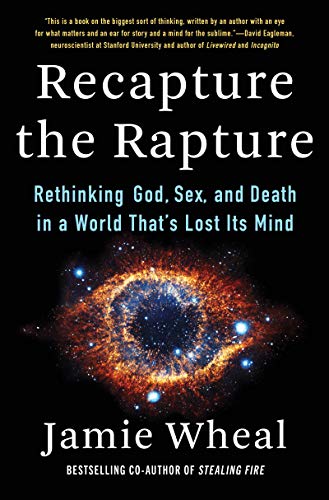
In Recapture the Rapture, we’re taking radical research out of the extremes and applying it to the mainstream–to the broader social problem of healing, believing, and belonging. It provides answers to the questions we face: how to replace blind faith with direct experience, how to move from broken to whole, and how to cure isolation with connection. Stated even more plainly, it shows us how to revitalize our bodies, boost creativity, rekindle our relationships, and answer once and for all the questions of why we are here and what we do now. – from the dust cover for Recapture the Rapture
Those are some seriously lofty claims, and I have to admit, I was slow to jump on the bandwagon and read this one. I kept hearing high praise for the book and author and I’m naturally skeptical. I wondered, “Can it really answer such deep philosophical questions and provide a road map for transformative, embodied spirituality?” But after seeing an interview with the author on one of my favorite podcasts, I gave in and picked up a copy. Jamie was impressive. The interview was nearly four hours long and he was razor sharp the entire time. Not only that, he spoke with a joy and exuberance of a man half his age, and everything he had to say was profound. I could tell he’s doing something right and I wanted to know more.
As soon as I started Recapture the Rapture I was hooked. Jamie’s background in anthropology and systems analysis help him astutely diagnose the meaning meta-crisis that humanity is facing and trace a rough history of how we got here. Namely from the collapse of meaning 1.0 (traditional religion) and meaning 2.0 (modern liberalism) which has left us in a world devoid of meaning. Of course, this won’t be a surprise to anyone familiar with John Vervaeke’s work and his epic series Awakening from the Meaning Crisis. But Jamie doesn’t stop there.
The book is broken up into three sections: choose your own apocalypse, the alchemist’s cookbook, and ethical cult building. Catchy titles I know. But what lies underneath is nothing short of remarkable. The first section talks about the collapse of meaning 1.0 and 2.0 and ends by asking the question, “What would meaning 3.0 look like?”. Which is probably the most important question that any of us could ask at this current point in time. In order to answer this question he looks to design firm IDEO for inspiration:
IDEO’s method is based on three principles: Inspiration, Ideation, and Implementation. In the first phase, Inspiration, you “learn directly from the people you’re designing for as you come to deeply understand their needs.” In the second phase, Ideation, “you’ll prototype possible solutions.” And in the final phase, Implementation, “you’ll bring your solution to life and eventually, to market.”
So that’s what this book is all about–bringing a Human-Centered Design process to the challenge of Meaning.
If Part One has been about deeply understanding our need for Exponential Meaning, Part Two is all about prototyping possibly solutions. Part Three will take those insights and explore ways to implement these ideas in the larger world. -Jamie Wheal, from section 1 of Recapture the Rapture
A great method for designing anything meant for humans, but he doesn’t stop there, he also acknowledges that for meaning 3.0 to have enough impact to change our current course it needs to be “broadly relevant and locally adaptive” to make it as inclusive as possible. To meet that goal he says it needs to meet three design criteria borrowed from meaning 2.0: Open Source, Scalability, and Anti-Fragility. For any solution to the meaning crisis to be effective it will need to meet all three criteria otherwise it will never the critical level of penetration needed to create cultural transformation.
Section 2 of the book builds upon this solid foundation and attempts to provide a practical protocol for building Meaning 3.0 by combining the “pro-social functions of traditional 1.0 Faith–Inspiration, Healing, and Connection” and the “inclusive promise of 2.0 Modernism, and be Open Source, Scalable, and Anti-fragile” (this is the exact road map that I’ve used to create my system of rational modern mysticism, by the way). He looks to the latest scientific research on embodied spirituality, flow states, and mystical experiences to find the most reliable and potent practices for propelling humans into higher states of consciousness which fall into five categories that make up the chapters of section 2: respiration, embodiment, sexuality, sacraments, and music.
Each chapter goes into the anthropology, neurophysiology, and practical applications of the selected category while providing incredible related stories. This advanced my knowledge of human physiology more than anything since my anatomy and physiology courses in school. Seriously. While most people attempting to provide solutions to the meaning crisis show clear bias in their treatment of modern embodied spirituality, Jamie manages to steer clear of that trap and review the literature objectively. For example, he spends two whole chapters reviewing the potential for sexuality to catalyze spiritual growth and the research he shares completely blew my mind and forever altered the way I think about sex and sexuality. It turns out that the most reliable method for producing profound mystical experiences is different for men and women, but you probably won’t hear that anywhere else. The alchemist’s cookbook outlines practices within each category for raising consciousness and even provides examples of how to combine them in new and remarkable ways and schedule them for a life of maximum meaning, inspiration, and creativity.
But the book doesn’t end there! Each section could easily be a whole book unto itself but Jamie wanted to provide a comprehensive answer to the meaning crisis which requires that we move beyond simply personal spiritual practices to community. And that’s what section 3, “Ethical Cult Building” is all about. That title may sound strange to you if you aren’t used to religious studies. You might be thinking that “ethical cult” is an oxymoron, an impossibility. But Jamie isn’t referring to the modern concept of the cult, he’s referring to the academic definition of a cult which is simply “a set of religious devotional practices that is related to a particular figure or is frequently associated with a particular place.” What you’re thinking of Jamie calls a “culty-cult”, in other words, an unethical cult.
It turns out that we have an innate human need to worship with others, to connect with others who believe and practice like we do, and that need has been starved ever since the decline of meaning 1.0. Unfortunately, many of the modern attempts to form spiritual communities have fallen prey to corruption which is exactly how we arrived at our modern vernacular definition of a cult. In order to help future spiritual communities avoid that pitfall Jamie provides an ethical roadmap for building spiritual communities. Communities that provide all three dimensions of transformative spirituality: ecstasis, catharsis, and communitas while avoiding corruption. He provides a checklist of “what not to do” as well as a list of what the community needs to come together and agree upon for maximum coherence and impact on culture.
Looking to our religious heritage again, what he calls Meaning 1.0, he identifies five core elements for forming a stable and ethical spiritual community: metaphysics, ethics, sacraments, scriptures, and deities. Metaphysics provides the solid ground for us to stand on to make sense of epiphanies and paradoxes and makes sure we don’t get destabilized or disoriented as we explore the great mysteries of life. Ethics provide the much needed guard rails to keep the community from going astray into “culty-cult” territory. As Jamie says:
If there aren’t guardrails to this experiment, no higher purpose or service, then it will be captured by Bliss Junkies endlessly chasing states, Epiphany Whores craving catharsis, or Gutless Groupies following gurus. Ethics are like the tail rotor on a helicopter–without them, we just spin in circles.
Sacraments provide reliable techniques of ecstasy to deliver direct experience of the sacred, revelatory insights, and potent bonding; and they help prevent what Jamie calls “voltage drop, as the immediate gnosis of a founder dwindles as it gets handed down.” Something William James also warned against in his monumental work The Varieties of Religious Experience:
A genuine first-hand religious experience is bound to be a heterodoxy to its witnesses, the prophet appearing as a mere lonely madman. If his doctrine prove contagious enough to spread to any others, it becomes a definite and labeled heresy. But if it then still proved contagious enough to triumph over persecution, it becomes itself an orthodoxy; and when a religion has become an orthodoxy its day of inwardness is over: the spring is dry; the faithful live at second-hand exclusively and stone the prophets in their turn. The new church, in spite of whatever human goodness it may foster, can be henceforth counted on as a staunch ally in every attempt to stifle the spontaneous religious spirit, and to stop all later bubblings of the fountain from which in purer days it drew its own supply of inspiration.
Scriptures provide us with the necessary narratives that we need to make sense of our lives and of those who have come before us. They provide connection to the past and examples of exemplars of humanity for us to aspire to. And, lastly, deities provide us a higher power to aspire and answer to, otherwise we are left with nothing but self-interest, which hasn’t worked out so well.
To recap: we are hurtling towards catastrophe, we can all feel it, and if we don’t change course soon humanity itself may not persevere. But all is not lost. Some of humanity’s brightest minds are aware of the problem and are zealously working on solutions, and in Recapture the Rapture Jamie Wheal has provided one of the most eloquent and thorough answers that has been formulated so far. Few books have had as great an impact on me and my work as this one. As the reviewer Julie Holland stated:
The death of belief has led to a collapse of meaning, and many of us are looking to neuroscience and psychology for inspiration and understanding. This enrapturing book not only details various drivers of our cultural evolution but becomes one itself.
(Link to purchase: Recapture the Rapture)
I highly recommend this book to any adult (some of the themes and stories are a bit mature for younger readers). It quickly found it’s way to the top of my favorite book list. If that sounds interesting to you and you’re interested in picking up a copy, you can use the affiliate link above to purchase one and small portion of the money will go to me to help with the costs of hosting my website.
Thanks for reading and thank you for your support!
Love,
Justin
❤️🙏☀️