
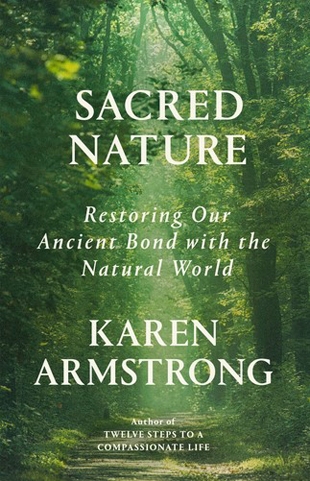
In Sacred Nature, Karen Armstrong draws on her vast knowledge of the world’s spiritual traditions to show how the sacrality of nature was central to human spirituality for almost all of our history from the Book of Job to St. Thomas Aquinas, from Lao Tzu to Wordsworth, how we lost our way, and how we might find it again.
She expertly reviews the spiritual traditions of the past to uncover the practices and perspectives that allowed them to live in greater harmony with the natural world and shows us how we can recover that worldview today. It is a relatively short book with few chapters but each chapter manages to be informative, inspirational, and practical. For example, chapter one is entitled “Mythos and Logos” and is about the importance of both ways of speaking about the world. She encourages us to recover the power of mythos and ends the chapter with practical advice:
Myth is not an inferior method of inquiry that can be cast aside when people have attained the age of reason. It is not an early attempt at history; it doesn’t claim to be objectively true. Rather, it helps us to glimpse new possibilities. In art, liberated from the constraints of logos, we conceive and combine new forms of expression that enrich our lives and tell us something important, giving us fresh insight into the disturbing puzzle of our world. Thus a myth is true because it is effective. The myths that we shall consider persisted for centuries, because they worked when people translated them into action. A myth is essentially a guide: it tells us what to do to live more richly and effectively.
For anyone familiar with the work of Joseph Campbell this will be really familiar territory. For most of our history, we had effective, powerful, and shared myths and we were very aware of our myths and used them to guide our behavior. But during the enlightenment we threw out the baby with the bath water and discarded most of our myths. Today we have our own new, modern myths (think Star Wars, Harry Potter, Lord of the Rings, Avengers, etc.) but we are rarely aware of what they truly are and, thus, we hardly use them to guide our behavior.
Each of the following chapters explores ideas, attitudes or practices that were essential to the way people experienced nature in the past. Each chapter offers a building block that will help us to create or discover within ourselves a new attitude towards the natural world and so deepen our spiritual commitment to the environment.
The ideas and attitudes covered include: the sacredness of Nature, the holiness of Nature, the brokenness of our world, the power of sacrifice, the benefits of gratitude, kenosis (or emptying of the self), the Golden Rule, and ahimsa (non-violence).
Each chapter begins with a historical overview and some comparative religion discussion showing how that concept can be found within different traditions and Karen does an incredible job of presenting a lot of religious history very succinctly. It’s a relatively short book, around 175 pages, but could essentially be an introduction to a religious studies or comparative religion course.
But it’s the endings of each chapter that most interested me since my focus is on the practical side of things. She ends each chapter with a section called “The Way Forward” in which she gives guidance on how to create a practice to recover that attitude on which the chapter is focused. For example, the chapter on kenosis, or emptying of self, ends with this instruction:
Every day, first thing in the morning and at night, for just a few moments we should consider three things: how little we know; how frequently we fail in kindness to other beings; and how limited are our desires and yearnings, which so often begin and end in our self.
To be honest, I was pretty sure I would love the book as soon as I saw the name; I didn’t even hesitate for a second to buy it, but Sacred Nature still surpassed my expectations. Karen’s depth of knowledge is impressive and her passion inspiring and the book reads like a combination of Joseph Campbell, John Vervaeke, and Rupert Sheldrake which, if you’re not familiar with them, is incredibly high praise. This was the first book I read by Karen Armstrong but it will certainly not be the last.
If you’re interested in environmentalism, religious history, comparative religion, or nature mysticism then you absolutely need to read this book.
(Link to purchase: Sacred Nature)
If that sounds interesting to you and you’re interested in picking up a copy, you can use the affiliate link above to purchase one and small portion of the money will go to me to help with the costs of hosting my website.
Thanks for reading and thank you for your support!
Love,
Justin
❤️🙏☀️