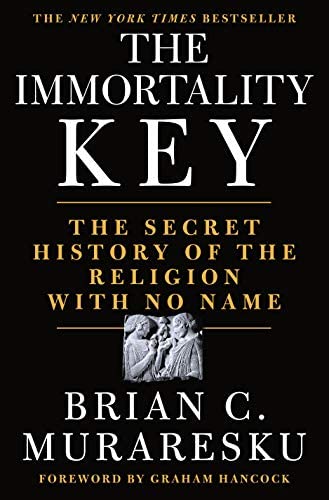
The Immortality Key by Brian Muraresku expertly challenges the prevailing narratives of the history of Western civilization and Christianity.
To be perfectly honest, when it first came out it was recommended to me by multiple people and was highly praised. So I looked it up and read a synopsis online, and at first I regrettably lumped it in with books such as The Sacred Mushroom and the Cross by John M. Allegro and ignored it. I had already read and researched that book and found that it’s claims were radical and mostly unfounded. It was a lot of wild speculation with very little evidence to back it up. I was also aware of another book which heavily influenced The Immortality Key and which is referenced many times throughout it called The Road to Eleusis by R. Gordon Wasson, Albert Hofmann, and Carl A. P. Ruck, however, I was unaware that anyone had decided to take up where they left off and look for more evidence, including hard chemical evidence of their claims. But this is exactly what Brian Muraresku did. In fact, Brian did a TON of investigation and research, over a decades worth, to put together this absolutely paradigm shifting work.
Well let’s just say it paid off. He had to search the Vatican Secret Archives, unheard of archeological sites, and closely guarded early Christian catacombs, but he managed to uncover shocking evidence that may forever change the way we think about the origins of Western Civilization and it’s oldest institution, Christianity. He details this investigation and his travels throughout Europe in the book and that is part of what makes it such a fun book to read. Think Dan Brown novels but real. It is an incredibly engaging book and I found it very difficult to put down. Brian is passionate and energetic and it really comes across in his writing. The book is so good, as soon as I finished it, I immediately gave my copy to a friend to read.
And I am certainly not the only one who feels this way. Almost immediately after it’s release The Immortality Key was being talked about and praised by people around the world, and not just the psychedelic evangelists/apologists. Scholars and academics started referencing it. Podcasters were scrambling to get Brian on their shows, and for good reason. His premise goes something like this:
Eleusis was considered by the Ancient Greeks and Romans to be a vital foundation to civilization. All of the important figures of the time were initiates including such influential figures as Plato and Marcus Aurelius. And the mysteries of Eleusis involved, among other things, the consumption of a special brew known as the kykeon. However, the details of what exactly happened at Eleusis and what the actual ingredients were for the kykeon were very closely guarded secrets. Secrets guarded by punishment of death. So we don’t know what exactly the kykeon was, however, we do have many accounts of people having powerfully transformative visionary experiences under it’s influence. Powerfully transformative visionary experiences that almost perfectly mirror modern day accounts of people’s experiences with psychedelic assisted psychotherapy. Therefore, it is not unreasonable to infer that the kykeon may have also been a psychedelic brew of some kind. So far, none of this is radical and is accepted by most scholars. But no one knew of any physical evidence to support this theory. That is until Brian uncovered a little known scientific paper in a obscure language, Catalan, that suggested that such evidence had in fact been found. He then goes on to reveal other evidence from finds in Gobekli Tepe, Egypt, Israel, and other places that suggests that psychedelic beers and wines were commonplace in the ancient world and that the knowledge of how to make these brews may even predate history as we know it. He even makes a rather convincing argument that brewing beer predates other uses of grains such as baking and that the agricultural revolution may actually have been the beer revolution. And, in fact, that ancient beer was used in highly religious contexts and ceremonies which could have been direct archaic precursors to Eleusis.
All of which is incredibly fascinating, but the really radical part of the book is centered around what is called the Pagan Continuity Hypothesis. The premise of which is that Christianity didn’t just spontaneously appear without any influence of the current cultures in which it appeared but that it adapted and continued some of the Greek and pagan traditions and incorporated them into the new religion. This is also not controversial. It is common knowledge that Christianity adapted some pagan traditions and celebrations such as Christmas. What is radical is that Brian suggests that the original Christian eucharist may have actually been a psychedelic wine and that it may have been produced almost exclusively by women. A continuation of the long tradition of psychedelic brews as sacrament. He provides incredible textual, archeological, and artistic evidence to support this theory. And by providing some much needed context about the Greek culture in which Christianity arose he shows that the original audience for which the gospels were written would have read them very differently than we do today, especially the Gospel of John. They would have understood the references that we so easily miss today. The Gospel of John has clear and deliberate references meant to appeal to Greek women familiar with the Dionysian cult, a cult centered around a psychedelic wine sacrament, and he makes it very clear that everything they used to get from Dionysus they can also get from Jesus and his wine sacrament.
He then goes on to ask the question, if all of this is true, what happened? When did the powerfully transformative sacrament get replaced with the placebo? And why? The answer it seems has to do with women. Specifically women who had advanced knowledge of plants and their potential medical and psychoactive properties. In other words, witches. Witches who challenged the church’s monopoly on healing. And, of course, he provides evidence from the Vatican’s own records to prove this.
The scope of the book is incredible, I know. From prehistoric graveyard beer to ancient Greek psychedelic ceremonies to medieval witches being burned at the stake for their knowledge of plants. It documents the eternal clash of two opposing worldviews, one which embraces and empowers women and the natural world, and one which seeks to subjugate and dominate them. A clash that is still ongoing today.
Now I do think it is important to note that Brian is himself a Catholic. He was raised Catholic, he went to a Jesuit university, got a degree in Latin, Greek, and Sanskrit, and most of the people he interviews and speaks with in the book are also Catholic. This book is not anti-Catholic, anti-Christian, or anti-religious, at all. In fact, here are Brian’s own words on the matter:
“I didn’t write this book to be anti-organized religion. In some cases, it’s the exact opposite. In the intro, I mentioned Brother David Steindl-Rast, a Benedictine monk who is a hero of mine. He talks about the tension between mystics and the dogma and doctrine of organized faith. I don’t think you can have one without the other. The balance, as Brother David says, is to rediscover that original visionary power and live in it as a lived experience. This is what Joseph Campbell says of religion being a lived experience. We’re talking about emotional potential. That’s how the great anthropologist Clifford Geertz defines religion: these powerful, pervasive, long-lasting moods and motivations. That only happens when you’re talking about something that gets inside of people’s bones. That’s what the mystical experience is; it’s how these religions are born. Brother David says it’s virtually impossible to start a religion without mystical experience, like Moses in the burning bush, Paul on the road to Damascus, or Peter, in Acts, caught up in a trance.”
The Immortality Key is an absolutely incredible book and one that I think everyone should read, especially if you come from a Christian background, like myself. It sheds some much needed light on the environment in which Christianity arose and tells the story of a part of our history which has mostly been forgotten. Forgotten not because it became irrelevant but because it was brutally suppressed for hundreds of years by the oldest and largest institution in the world, the Catholic Church. But I believe, as does Brian, that hidden within that forgotten part of our history lies the answer to the meta-crisis facing humanity today. The Immortality Key itself is that answer which, by the way, is not a substance or a drug, but an experience. The experience of dying before death. Which is why the book opens up with a quote which is inscribed at St. Paul’s monastery on Mount Athos in Greece and it may sound strange to us today, but to the ancients this wasn’t strange at all:
“If you die before you die, you won’t die when you die.”
That may sound cryptic but it reminds me of the second to last stanza of St. Francis of Assisi’s great poem, the Canticle of the Sun, which reads like this:
“Woe to those who die in mortal sin.
Blessed are those who will
find Your most holy will,
for the second death shall do them no harm.”
Together I think these both start to make a little more sense. How do you find God’s will for your life (“Your most holy will”)? By dying before you die of course. Then, there is the promise of immortality, “the second death shall do [you] no harm”/”you won’t die when you die.” Simple right?
If that sounds interesting to you and you’re interested in picking up a copy of The Immortality Key yourself, you can use the affiliate link below to purchase a copy and small portion of the money will go to me to help with the costs of hosting my website. Thanks for reading and thank you for your support.
Love,
Justin
☀️🙏❤️
Link to purchase: The Immortality Key