
Raja Yoga is known as the psychological path of yoga. The version that I practice is based on the teachings of Swami Vivekananda and Patanjali’s Yoga Sutras and is based around meditation.
Introduction
Yoga is largely misunderstood in Western society. It is mostly known as a form of physical exercise consisting of stretches and postures (asanas). However, this is only one small fraction of what falls under the vast umbrella of yoga, and is only meant to be part of the process, not the entirety. Yoga means union with God or to yoke with God. That is the aim or goal of all teachings of yoga. To yoke yourself with God is to be in harmony with God, not to become God. This is another common misconception. Though you should gain a clearer view of the divinity within yourself as you practice. Yoga paths are specific sets of teachings meant to help bring people closer to God. There are countless varieties or paths of yoga but there are said to be four main paths: karma, jñana, raja, and bhakti. Karma yoga is the path of selfless work or action. Jñana yoga is the path of knowledge. Raja yoga is the path of psychology, or meditation. And Bhakti yoga is the path of loving devotion. Every individual being is said to be more inclined to one of these paths but, ultimately, it is best to incorporate some of each in your journey towards self-realization or yoking with God. In this series on yogic paths, I will go over all four of these, and more, starting, with Raja Yoga.
Raja Yoga
I see the value in the variation of yoga and the broad reach it can achieve because of its variety. So I made it a mission to study and practice as many yogic paths as possible and to share my experiences and knowledge. I hope that by sharing more perspectives and styles, more people will benefit. There is a yoga for everyone. I have been studying and practicing Raja yoga for three years now, and I will likely practice until I die. I can’t see any reason to stop. I certainly have much to learn, but I have been able to dive into it deep enough to really understand it and the incredible benefit it can bring to our lives.
The goal of this path of yoga is to still the movement of your mind. Each part is specifically designed with this goal in mind. But Patanjali starts off his Yoga Sutras with some definitions and philosophy, so I am going to do the same.
First, it is important to elaborate on our goal; stilling the movement of our mind. There are five categories of mental movements:
- Correct Knowledge/Thinking
- Erroneous Thinking
- Imagination
- Sleep
- Recollection/Remembering
Obviously, all of these movements are necessary for living, and we are not meant to still them at all times. The point is to develop a way of life and a set of practices that allows you to still them when you want to or need to. This ability, when developed, can help you deal with things like rumination or anxious thoughts, negative self-talk, negative thoughts about others, and more; which can have a dramatic effect on your inner life. I call this mental process detachment because you are developing the ability to detach from thoughts that don’t serve your higher purpose. Detachment can help to still your mind when it is being reactive or emotional.
But there is also another way to still the mind. The opposite mental process: concentration. This is the ability to focus the mind onto a single object and I will go into further detail on this later because it is one of the eight-limbs of Raja yoga practice. Vivekananda said that to develop concentration and detachment together turns the mind into a perfect instrument for learning, but one without the other will lead to suffering.
There are many benefits to being still. Most of you probably know the words, “Be still, and know that I am God,” for example. According to Patanjali, the reason we want to still all of these mental movements is that we are then abiding in our true nature. Otherwise, we mistakenly identify with those movements. We think we are something small, and fleeting, and volatile, but, in reality, we are expansive, and eternal, and peaceful. But we have to still those movements, for at least a moment, to see that.
It’s all about practice. In fact, according to the Yoga Sutras, the way to master this process of stilling your mind is to practice continually while having an attitude of detachment, even from the results of your practice. If you are too focused on obtaining results you are unlikely to meet your expectations. But you also cannot cling and resist change.
Correct/Incorrect Thinking
Since we have made a distinction between correct thinking and incorrect thinking, it is important to discuss how to distinguish between the two. Epistemology is the theory of knowledge and how to determine what is a valid source of knowledge. This references the first type of mental movement: correct knowledge and thinking. According to this tradition there are three valid sources of knowledge:
- Direct Perception
- Inference
- Trusted Testimony
Direct perception can be something we see, hear, or feel, or evidence that we see. And trusted testimony would be expert opinion or scripture. However, all of these still have limits and are fallible. Even our own direct perception could be wrong so be sure to cross-reference.
Incorrect thinking can be based on false appearances or if our sense perceptions fail us, such as when we hear something completely different than what was actually said. But there is another kind of incorrect thinking according to Raja yoga, and that is thoughts of harm or other negative thoughts towards others.
The reason is that dwelling on such thoughts, even if you think they are justified, will bring you endless misery and inner turmoil, and we are working to develop a lifestyle conducive to stillness. But there is a remedy prescribed for when we do have such thoughts about someone because we are flawed, and it is inevitable that this will be something we encounter.
Meditate on the Opposite
Learn to recognize incorrect thinking by building mental awareness and vigilance, and when you find yourself being drawn into it, instead, meditate on the opposite. This means think of what you like about that person, positive traits that they have, and positive memories you have with them. To show even your enemies and antagonists mercy and compassion is a radical act, and will bring you much more peace than any vengeance or spite ever could. Harboring resentment towards others will prevent you from finding peace and being still, so that must be discarded. It will lift a huge burden off your shoulders to let that go.
Every time you find yourself thinking a negative thought about someone, immediately stop yourself, and think something positive about them instead. It will free so much space in your heart to fill with love.
The remaining three mental movements: imagination, recollection, and sleep are fairly self-explanatory so I won’t go into detail defining or explaining them but, if you’re interested, the Yoga Sutras do go into further detail on all of this.
As we practice and work on being still we will be developing the powers of concentration and detachment but we will also be diminishing our afflictions. These afflictions are: ignorance of our true nature/lack of self-realization, falsely identifying with our body/mind, desire, aversion, and clinging to life or our survival instinct. Afflictions are all things that will hold us back from our goal of stillness and drawing ever nearer to God. I’ll talk more about afflictions in future posts.
The Eight Limbs
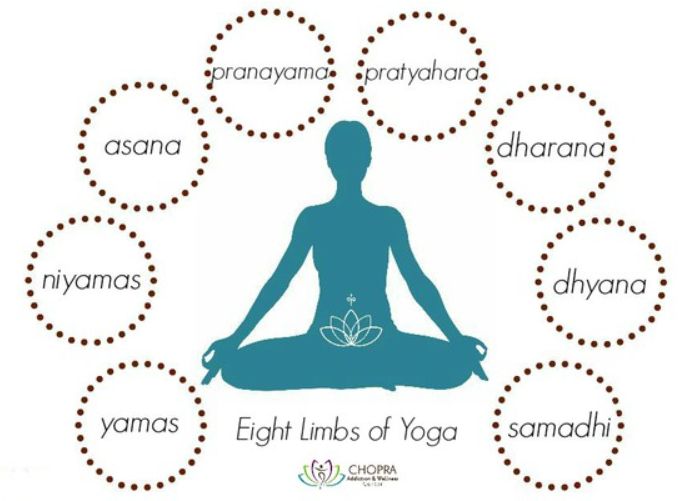
Raja yoga is sometimes referred to as ashtanga yoga, which means eight-limbed, because there are eight parts of the practice:
- Avoidances (Yama)
- Observances (Niyama)
- Posture (Asana)
- Breath/Energy Control (Pranayama)
- Sense Withdrawal (Pratyahara)
- Concentration (Dharana)
- Meditation (Dhyana)
- Absorption (Samadhi)
Avoidances (Yama)
There are five avoidances. They address different aspects of our lives, and how to live in a manner that facilitates a peaceful and meditative state of mind. The practice of struggling against our lower nature and desires serves to strengthen our higher nature. It is the foundation upon which all spiritual progress is built. This begins the purification process of mind, body and heart. In his Yoga Sutras, Patanjali also discusses the benefits that each of these will bring to our lives.
- Do No Harm (Ahimsa)
- Don’t Lie (Satya)
- Don’t Steal (Asteya)
- Practice Sexual Restraint (Brahmacharya)
- Don’t Be Possessive (Aparigraha)
Do No Harm (Ahimsa)
This is the most important of the avoidances because if you follow this, you won’t, for instance, lie or steal. So that’s two more of the avoidances that are covered by properly adhering to ahimsa. And this is to be followed in all circumstances and without any excuses. Patanjali makes it explicitly clear that we are not to harm or even wish harm on another, even if they intentionally harm us. Reminiscent of the Bible’s ‘turn the other cheek’ philosophy. It must be stressed that this practice is both external and internal. Not harming others means not only restraining from harmful actions and words but also thoughts, and this should extend past other humans, to other animals, plants, and to the entire world. When you become established in this practice you will notice an abandonment of hostility in your vicinity. Animals are especially keen on this. They can really sense if you mean them no harm and they are drawn to people who embody this principle.
Don’t Lie (Satya)
It’s pretty easy to see the benefits of this one. Every time you lie that creates a point of stress and chaos within your mind and your life, and our goal is to live a lifestyle that fosters peace and harmony. Truthfulness will aid us in that pursuit greatly. When we are established in truthfulness we can rely on the results of our actions. When we lie, we invite doubt into our lives, but when we tell the truth, we establish confidence. We also align ourselves with reality, with Nature, and begin to understand its laws and cycles, and see with a vision that extends past the present.
Don’t Steal (Asteya)
This is pretty straight-forward as well. Don’t steal, don’t even have the intention of stealing, or think about stealing. That means don’t be envious, don’t covet what anyone else has and respect what belongs to others. Once again, this is because stealing will invite chaos and stress which we are trying to avoid. But establishing this attitude also allows us to truly enjoy things. We no longer have the need to possess them. We can just enjoy them as they are.
Practice Sexual Restraint (Brahmacharya)
This has come to be equated with celibacy for a lot of people but that is not the intention because this is meant to be something that can be practiced by all people, even those who are in a sexual relationship. So, instead of pure celibacy, those who are in relationships, are to practice restraint. This is so that sexual thoughts and urges don’t take up too large a part of our mind and our time. It will be distracting to our meditation practice and we can use that vital energy for other purposes. This leads us to the benefit of establishing sexual restraint which is virility or vigor.
Don’t Be Possessive (Aparigraha)
Do not cling to what is yours. Be willing to share. Remember that everything we possess here is temporary anyway, and we are all connected. When you become established in the practice you will no longer depend on your possessions. You will become truly free. Patanjali basically said the ancient Indian equivalent of, “You will understand the meaning of life.” Which is a grand statement, but when you realize that life isn’t about having possessions, it is much easier for you to see what really matters.
Observances (Niyama)
There are five observances which are meant to help us live a life of peace and virtue. Yama and niyama are essentially the do’s and don’ts of yoga. So yama were things that we shouldn’t do and niyama are things we should do.
- Purity (Shaucha)
- Contentment (Santosha)
- Self-Discipline (Tapas)
- Study of Self and Scripture (Svadhyaya)
- Devotedness to God (Ishvarapranidhana)
Purity (Shaucha)
This could also be translated as cleanliness but it is a holistic kind of cleanliness. Clean body, mind, and heart. As you practice purity you begin to feel less attachment to your body and to others. Many people feel drawn to isolation but that is an extreme example. For most, you just won’t feel as much of a need to be around others and will be more at home alone. It only makes sense that you would feel more comfortable with your self if you are clean and pure. But there are other benefits as well. It will bring you peace and serenity, help you concentrate and be still, increase your control and mastery over your senses, and prepare you to see God. As the Bible says, “Blessed are the pure of heart, for they shall see God.”
Contentment (Santosha)
Contentment is accepting reality as it is right now. It doesn’t mean resignation. You can still work to improve yourself and your circumstances but you also have to accept the reality of your current self, with whatever flaws and faults you may have, and your current circumstances which can change quite dramatically and quickly. Resisting and denying will only bring you suffering and introduce chaos into your life and mind. Accepting and establishing contentment will bring you true joy and unsurpassable happiness because it comes from within and is not dependent on circumstance.
Self-Discipline (Tapas)
These next three observances make up what is known as Kriya Yoga, or practical yoga, starting with self-discipline. Discipline is necessary for progress down any spiritual path. And Raja yoga’s chief concern is establishing stillness through a regular meditation practice, so discipline is crucial to maintain the practice. Patanjali tells us that self-discipline will eliminate our impurities and bring us efficiency of our body, our senses, and our mind. It tunes us to be a perfect tool for meditation. I love what Vyn Bailey had to say about it in his translation and commentary on the yoga sutras:
After a week or so the novelty begins to wear off and self-discipline is needed to keep faithfully to our daily practice of postures and breathing routines. We know we should, but the body doesn’t want to. After a few weeks of perseverance the body realizes it never felt better. The body has learned to submit to the mind–and to enjoy the experience. With time the mind will learn to submit to the spirit, and those unattractive quirks in our personality will be progressively ironed out. Finally the spirit itself will learn to submit to God, and we shall have arrived.
Vyn Bailey, Patanjali’s Meditation Yoga
Study of Self and Scripture (Svadhyaya)
This one can be translated to be study of scripture or self. In the time and culture the Yoga Sutras were written, scripture was passed down orally. Yogis would have memorized and studied scripture by repeating it out loud to themselves, or in their minds, and contemplating upon it. Personally, I think study of scripture such as the Bible or the Vedas is highly important to the process. It is important to study something that is spiritual and inspirational, and helps you on your journey. But what is equally important is to study yourself. To observe your inner states and your reactive behaviors. As you practice, you will watch yourself grow and grow closer to God. This is how we reach the state of yoga or yoking with God, through studying God’s word. In yogic tradition, this would lead you to a mystical God vision experience and contact with your chosen deity, or devata. But these visions or contacts with chosen prophets or God are common throughout Christian tradition as well. By studying the Word of God, or of a prophet, you to tune yourself to see that divine ray of light which is their true form and which exists beyond time.
Devotedness to God (Ishvarapranidhana)
Kriya yoga concerns the holistic development of the individual so it prescribes three practices: self-discipline for the body, study for the mind, and devotedness to God for the spirit. A lot of people have a problem with this part because they don’t believe in God. And that’s okay. Raja yoga is a secular practice and, for many people who practice, God means Higher Self or True Self. I urge you to find a definition of God that has meaning to you and devote yourself to that. Our devotedness to God will perfect our absorption (samadhi). The process of defining God will be covered extensively but separately as a part of Jñana Yoga.
Posture (Asana)
Remember that yoga is the stilling of the movements of the mind and that is accomplished through meditation. The rest of Raja Yoga, limbs three through eight, have to do with the actual practice of meditation, beginning with posture.
While most people think of yoga as being mainly about posture, it actually takes up a very small part of Patanjali’s teaching, and it isn’t until later commentaries that specific postures are recommended. We are simply told to find a posture that is comfortable and that allows us to be still for long periods. It is generally recommended to use a seated posture like Egyptian, which is seated in a chair, or Lotus, seated on the ground. You could also use Corpse pose, lying down on your back. Whatever pose you choose, you should take some time getting nestled into place, and making sure you are sitting up straight and your spine is aligned.
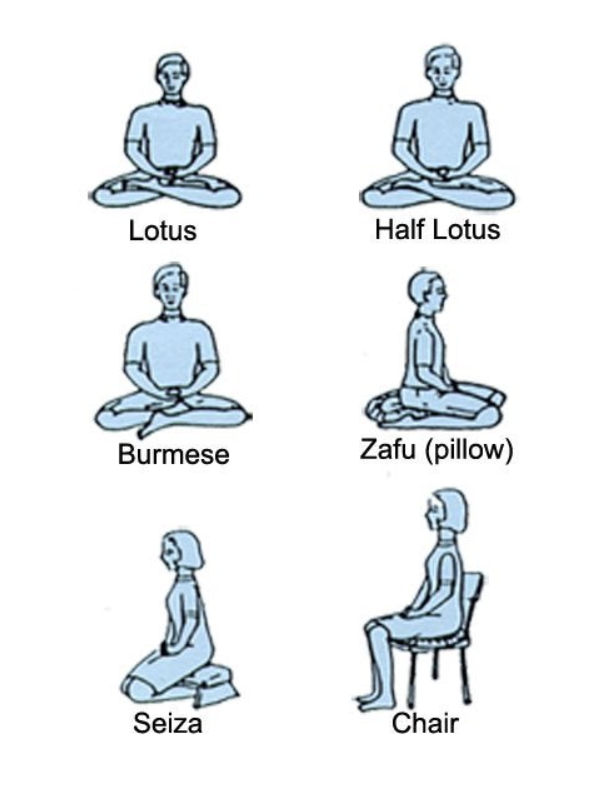
Don’t try to start meditating right away, just focus on your posture awareness. Take some time until you relax into it. When that happens you should start to feel expansive, and stop identifying as strongly as your body, and more as your infinite, expansive Self.
Breath Control (Pranayama)
Once you have mastered your posture and relaxed into place you should then move your focus to your breath. Controlled breathing comes in many variations but it also comes with many benefits both physical and mental. There has been a lot of scientific research recently into the benefits of controlled breathing and techniques like those described in ancient yoga texts. The one I recommend is very simple and covers all three aspects of breath control: inhalation, exhalation, and suspension.
The Fourfold Breath
- Inhale deeply through the nose while counting to four.
- Hold while counting to four.
- Exhale completely through the mouth while counting to four.
- Pause while counting to four.
After a few repetitions this becomes much easier and it has a strong calming effect. Your breathing should become much more controlled over time. Then, you can stop the above breath control and just observe the breath. Take a few minutes to just bring the awareness to the breath until your mind stills even further, and you may not even notice if you are breathing in or out. When you firmly establish breath control, the veil over the light diminishes, and you begin to see your true Self shine through, and your mind is fit for concentration.
Sense Withdrawal (Pratyahara)
Pratyahara is the practice of internalizing the senses or bringing your focus to your mind so that external sensations are prevented from reaching your consciousness. A common practice in Raja yoga is to bring your focus to the point between the eyebrows, the third eye, or to the heart. This step represents the transition from the external limbs to the internal, and is the final preparation before samyama, or integration, which constitutes the final three limbs of concentration, meditation, and absorption.
Once you’ve got your posture and breathing under control, it is time to turn to your senses. We are working to still all the movements of the mind and external sensations cause big, distracting waves. So we bring our focus to an internal point and use that as our center. I like to use the heart, or heart chakra, because it is good preparation for the specific meditation I use immediately after. Whatever you do, continue to relax and bring your awareness within. Letting physical impressions fade and bringing your consciousness fully to the mental plane.
You may have noticed that a lot of meditations have you close your eyes and use visualizations; this is a process of pratyahara. It is bringing the visual sense under control of the mind, internalizing it. Patanjali tells us that establishing sense withdrawal gives us complete cooperation of our senses because it brings them under our conscious control. Once again, take a few minutes to work on this stage before moving on in your daily practice. It is important not to skip or gloss over any of the steps. Remember to have patience and take your time. You may spend your first several sessions only getting up to this point, or not even make it this far, and that is completely normal.
Concentration (Dharana)
We have been working to bring serenity, and peace to our lives by practicing the first two limbs, the avoidances and observances, stilling our body and mind by practicing the next three limbs, posture, breath control, and sense withdrawal, and now we are ready to start focusing. This may seem contradictory to you because we have been working so hard to still movements of the mind and now we are trying to create movement. But, in the end, this will aid us in our goal of stillness. We have been working on detachment and now we are going to start attaching the mind to an object, concentrating.
The object of our meditation can be anything but it is recommended to be God, or the Self, which is seen as an expression of God. This can seem daunting or too abstract for many, so instructions like the example below are often given to help guide the mind. If you have already brought your attention and focus to your heart, or heart chakra, you can easily transition to this meditation:
“Think of a space within your heart, and in the midst of that space is a flame. Think of that flame as your soul, your true Self and inside that flame is an effulgent light, the Soul of your soul, God.”
Swami Vivekananda
Bringing the mind to this object is dharana, or concentration.
Meditation (Dhyana)
Once we have concentrated the mind, we then have to hold it onto our object, and let the full power of our focus and consciousness flow towards it. We are creating a big wave in the mind to wash away all others. We have been stilling the mind and reducing all the normal agitations that plague us, and now we are building a singular wave of our own choosing. Once the mind has become only this one wave, one movement, that is dhyana. It is simply maintaining concentration. This is what all of our practice has been building towards. The discipline, strength, and confidence that we have built through controlling our posture, breath, and senses was all preparation for this.
In your daily practice, you will end up spending the greatest amount of time in this stage. This is the yoga of meditation after all. But every part is important. It is recommended to spend about five minutes on posture, five minutes on breath awareness, a couple minutes on sense withdrawal, and then a minimum twenty minutes on samyama. Concentration, meditation, and absorption will all flow one into the other, back and forth, as you practice.
Absorption (Samadhi)
Samadhi is a difficult term for a lot of people to grasp. At least in the West. It means something like contemplation or absorption. With prolonged deep meditation you can become so absorbed that you lose the sense of even your own identity. You lose the sense of separation between you, the act of meditating, and the object of your meditation. It all becomes oneness. That is samadhi. Complete absorption.
So, the path of Raja yoga starts with learning to identify the movements of the mind, then learning to subdue them, then learning to create one wave so powerful that it suppresses all others, then, when there is only one left, we calm that one as well, and when that is gone, what is left? Only awareness, samadhi, and the soul, the Self, is seen as it truly is. It’s like the soul is at the bottom of a lake and the movements of the mind agitate the water and disturb the appearance, but with the body and mind still, the soul can be seen shining in all its divine glory.
In true spiritual contemplation a Yogi will be able to see the very foundations of his mind, and it will be under his perfect control. As a result, he will attain to the goal of Raja Yoga, the complete suppression of the waves of the ocean of the mind. Then, the glory of the soul, undisturbed by the distractions of the mind or the motions of the body, will shine in its full effulgence; and the Yogi will find himself as he is and as he always was, the Essence of Knowledge, the Immortal, the All-Pervading, and Eternal Spirit.
Swami Vivekananda, Pathways to Joy: Dhyana and Samadhi
That is the essence of Raja Yoga. It’s a way of life, a practice, a journey inward. It’s just one of many paths to personal development. But it is an old and revered one. If it speaks to you, I urge you to take up the practice and see what develops. Pick up a copy of the Yoga Sutras or Vivekananda’s Raja Yoga for further study and development. Vyn Bailey’s translation and commentary are great for a Western/Christian audience because his background was as a lifelong Christian minister. But it doesn’t matter what religion you practice, or if you aren’t religious, anyone can benefit from incorporating some Raja Yoga into their life.
❤🙏☀