Over the last one-hundred years Western culture has imported and adapted quite a few concepts from Eastern philosophy, one of the most well known being chakras. But, like most concepts imported from the East (check out my post on yoga for another example), the chakras, and their meaning and purpose, have largely been misunderstood. So this post is an introduction to chakras for a Western audience because I believe that they compose an elegant and practical map of human consciousness and development and when understood correctly can help us understand ourselves more deeply.
So, what are chakras?
First of all, it is important to distinguish between our physical body and our energy body. These two overlap and interpenetrate each other but it is important to know the difference because you will be very confused if you conflate the two, especially when it comes to chakras. Chakras are a map of specific points in our energy body but many people misunderstand this and think they point to specific organs or parts of the physical body. For instance, the heart chakra does not refer to our physical heart but to a point in the center of our energy body. If you were to correlate that to a point in our physical body it would be in the center of the chest near the heart, but that location is supposed to be symbolic. The heart chakra symbolizes the threshold between our unconscious and our conscious self. With three chakras below representing aspects of the unconscious and three chakras above representing the conscious.
The chakras correlate with specific body parts and organs but in the symbolic understanding of those organs. So the heart chakra relates to emotions not the business of pumping blood throughout the body and the sacral chakra which correlates with the sexual organs relates to connection and intimacy. So in order to understand chakras you have to think in terms of symbolism.
I also want to note that there are a vast number of different chakra systems and traditions all with differing numbers of chakras. However, since this is an introduction to chakras, and not an advanced course, I am going to stick to the most common system, at least here in the West, of seven chakras.
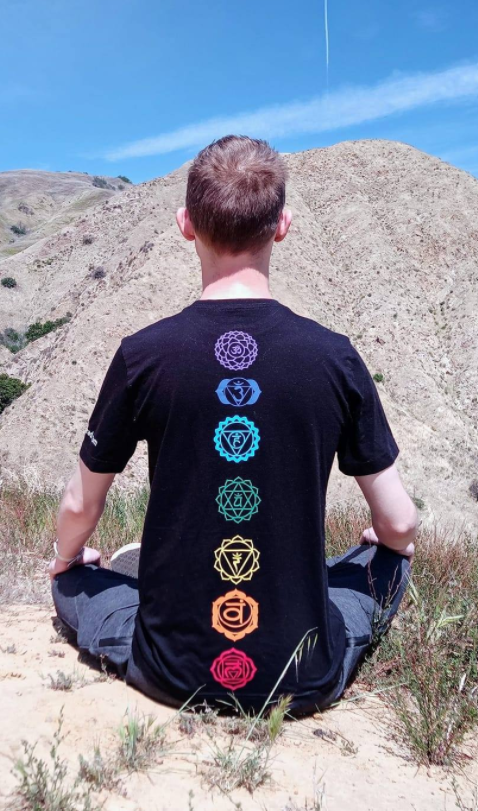
The Seven Chakras
Those seven chakras are:
- Muladhara Chakra or Root Chakra
- Svadisthana Chakra or Sacral Chakra
- Manipura Chakra or Stomach Chakra
- Anahata Chakra or Heart Chakra
- Vishuddha Chakra or Throat Chakra
- Ajna Chakra or Third Eye Chakra
- Sahasrara Chakra or Crown Chakra
These seven chakras are aligned along the center of the body from the root of the spine to the top of the head and along the central energy channel of the body known as the shushumna. Chakra is a Sanskrit word that means wheel. So when a chakra is “open” that wheel is spinning quickly and a lot of energy is freely passing through it, but when it is blocked that wheel is spinning very slowly and the energy flowing through is restricted.
Unblocking Chakras
In this way the chakras can help us understand and identify opportunities for growth and development. For instance, our throat chakra can become blocked by not expressing ourselves authentically. This can often manifest in physical tension and other issues in or around the throat. This is extremely common today. As anyone who has spent time around young children knows, we are born freely expressing ourselves and playing with the capabilities of our voice. But that free and authentic expression is often unwelcomed by adults who don’t feel free to authentically express themselves and therefore find it disturbing when others do. So we are yelled at and told to be quiet, to stop crying, to hold our tongue, and not go around screaming and shrieking and laughing out loud because that “disturbs the peace”. So we stop playing with our voice and our expression. We keep things in and we forget our potential and we build up barriers around our throat chakra that slow the flow of energy down to a trickle. I’ve heard therapists who work with adult men say that this issue arises in nearly every man they work with and some form of vocalization exercise that involves playful or otherwise unimpeded vocal expression is a core part of the therapeutic process.
But remember that the throat chakra doesn’t just refer to the actual throat and to vocal expression. It refers to creative expression through any medium. So a blocked throat chakra could result in writer’s block or in a lack of inspiration to create visual art. But when you get the energy flowing again by unblocking the chakra that creative energy can flow again and inspiration and passion often return. The process of unblocking can take many forms such as art therapy, talk therapy, group singing, etc. But the idea is that when you learn to express yourself authentically in one way that translates to being able to express yourself authentically in other ways as well.
Ok, so that should give you enough knowledge about the basics of chakras to begin to form a frame through which to view them properly. Now I want to return to the seven chakras and go through each one to give you an idea of the symbolism behind each one. There are entire tables and list of correspondences for each of the chakras but I don’t want to get into all of that in this post for a number of reasons. One is that much of that symbolism is rooted in the Vedic worldview which is entirely foreign to Westerners and if I were to describe it to you without providing extensive cultural background knowledge you would almost assuredly misunderstand it. For example, if I were to describe the deities that correspond with the root chakra such as Dakini holding a spear, a staff with a skull atop, a sword, and a cup you would likely have no idea what I’m actually talking about and how it should be symbolically understood. Explaining that cultural context is outside the scope of this post, so for now I will only relay the correspondences which can be understood without it.
Muladhara/Root Chakra
This chakra corresponds with the color red, the element of earth, the sense of smell, and the animal symbols of the bull, the elephant, and the ox. It refers to survival and stability and our base needs like food and shelter. The symbol for this chakra contains a square in the center of a four-petaled lotus. This is because the number four and its associated geometric symbol, the square, represent stability, both in the East and the West. Muladhara comes from two Sanskrit words that mean root and support. This chakra refers to our survival instinct and drive and our connection to the earth and the physical world. When it is functioning properly, we have the drive to battle against diversity and adapt to new circumstances. This is our root because without this basic drive we would have no will to do anything.
Whenever we draw energy up from the earth into our energy body it must pass first through the gateway of the root chakra, just as it must pass through the crown chakra when we draw energy down from the heavenly realm. Thus the human becomes the bridge between heaven and earth.
When this chakra is blocked it can manifest in symptoms like obesity, constipation, co-dependence, neuroticism, and anxiety.
Svadisthana/Sacral Chakra
This chakra corresponds with the color orange, the element of water, the sense of taste, and the animal symbols of the fish and sea creatures. It refers to pleasure, sexuality, and creativity, and our need for connection. In contrast to the stability of the element of earth of the root chakra, the sacral chakra is associated with the element of water which has no fixed form. The element of water and the sacral chakra are associated with the moon and its quality of reflection. The moon is a symbol of the emotions and both the personal and collective unconscious. When this chakra is functioning properly we are imbued with a sense of self-confidence and creativity and our sexuality is either integrated or transmuted and provides us with a source of energy and inspiration.
When this chakra is blocked it can manifest in symptoms like sexual aggression, frustration, or addiction, an overemphasis on shallow sexual activity, and this often results in creative frustration as well and hinders our ability to connect with others. Conversely, it can also manifest in impotence and lack of desire depending on the nature of the blockage. When energy flows into this chakra but not out, our consciousness becomes stuck there and unable to move on, but when energy is blocked from flowing into this chakra due to trauma or repression or something else we suffer from a lack of inspiration, desire, and self-confidence.
Manipura/Stomach Chakra
This chakra corresponds with the color yellow, the element of fire, the sense of sight, and the animal symbol of the ram. It refers to our will, ambition, and drive to be productive and active and also to intense emotions both intense joy and anger. This chakra is often referred to as the “solar plexus chakra” which I avoid because that tends to cause confusion. It does not refer to the physical location of the solar plexus or its symbolic meaning. It refers to the digestive system including the stomach. The stomach represents a great source of energy for productive action. Just as fire breaks down wood as it uses it for fuel, the acid in our stomach breaks down our food so that we can use it as fuel. And the stomach chakra is said to extract and store prana, which means energy or life force.
When this chakra is functioning properly our actions align with our word and our deepest feelings and our core values give us the drive and strength we need to act with conviction. When it is blocked we see ourselves as victims of fate and circumstance and we lack the willpower for self-determination. We are easily swayed by others and lack conviction. This can manifest in digestive system disorders such as ulcers, the feeling of having a knot in your stomach, lack of drive, and an inability to healthily express our emotions, especially anger. These emotions then get bottled up and build up within this chakra unable to be expressed and released. This blockage usually has to be cleared by a powerful emotional event or catharsis. And recent scientific research has shown that the vagus nerve which connects our gut to our brains can reliably produce such catharsis when properly stimulated.
Anahata/Heart Chakra
This chakra corresponds with the color green, the element of air, the sense of touch, and the animal symbols of the gazelle and the dove. It refers to love and compassion, balance, and calmness, and marks the point of transition from the lower self to the higher self. It does not refer to romance or personal love but to universal compassion and unconditional love. It is through this chakra that divine love flows through us and out into the world. A good example of someone with an open heart chakra is Mother Theresa who said, “Let Him empty and transform you and afterwards fill the chalice of your hearts to the brim, that you in turn may give of your abundance.” And another is Jesus Christ himself who has become equated with living with an open heart chakra. Think of his powerful words on the cross in the midst of agony, “Father, forgive them, for they know not what they do.” That is universal compassion and unconditional love.
The key to keeping this chakra functioning properly is vulnerability and an openness to both the ups and downs of life. When the heart chakra is open we feel love deeply but along with that can come deep feelings of grief because grief is just love without someone to direct it towards. Anahata means unhurt or unstruck and refers to the ability to integrate and transcend polar opposites and to meet all the different experiences of life with openness. The opening of the heart chakra is associated with spiritual awakenings and mystical experiences and this is where our uniqueness as human beings really begins. But this opening can be a long and difficult process. The world can be harsh and traumatic and we often build up many barriers around our heart to protect ourselves. Or we don’t believe ourselves worthy of love and so we don’t allow love to flow through us. When this chakra is blocked it can result in an inability to feel or express love and compassion, and circulatory system disorders such as heart disease and lung disease.
Vishuddha/Throat Chakra
This chakra corresponds with the color bright blue, the element of spirit, the sense of hearing, and the animal symbol of the elephant. It refers to communication and creativity and self-expression. Vishuddha means pure or to purify and this chakra is associated with purification. And this is a reminder to be truthful in the way we communicate and that being truthful purifies us. It is said that speech has the ability to create and the universe itself came into being by way of divine speech. We see this in creation stories both religious and fictional. In the bible we have, “In the beginning was the word and the word was with God and the word was God.” Similarly, in the Vedas we have, “In the beginning was Brahman with whom was the word and the word is Brahman.” There is also the example from Tolkien’s Silmarillion in which the universe is sung into existence. Again and again we see the pattern, divine thought becomes divine word or sound which becomes matter.
The sense of hearing which this chakra refers to is not just physical hearing but spiritual discernment and the ability to be still and hear the subtle whisper of the divine which we can only hear when we have developed our spiritual sense of hearing. There is a link between this inner hearing and creativity. Artists often say that their art flowed through them, that it was channeled or received from divine inspiration. Musicians hear music in their mind and writers experience inner dictation and dialogues. When this chakra is functioning properly we can discriminate between group think and the lies of the ego and that subtle quiet voice of the divine. We can express ourselves authentically and we can create harmony with our speech. When blocked it results in an inability to express ourselves authentically which often results in existential crisis. It can also manifest in physical symptoms like an inability to sing, tension around the throat, and hoarseness of the voice. When the heart chakra is blocked the throat chakra will almost always be blocked as well. We cannot express ourselves authentically unless we can be vulnerable.
Ajna/Third Eye Chakra
This chakra corresponds to the color indigo but has no associated element, sense, or animal symbols. That is because we have moved into the realm of the abstract. It refers to direct perception, intuition, visualization, imagination, and self-mastery. Ajna means to know, to perceive, and to command and can be thought of as the command center of the whole being. Direct perception is gnosis, or intuitive perception, or anthro ontological perception, and means to see more clearly than we can with our physical eyes which easily fall prey to illusion and deception.
Someone with a functioning third eye chakra can see through attempts at deception and the illusion of separation. They see themselves as part of a great web of life that incorporates the entire cosmos and they see their lower and higher selves as parts of one unified whole. This is in contrast to heart chakra level of consciousness in which the higher self is known but externalized. Here the higher self is seen as not some distant ideal out there but some part of us deep within. When Jesus says, “I and the Father are one.” This is an expression of third eye level consciousness.
When this chakra is blocked we experience an inability to visualize, a lack of imagination, and a disconnection from our intuition. We are easily manipulated and deceived. And it can be unblocked by practicing visualization and cultivating intuition through practices such as divination.
Sahasrara/Crown Chakra
This chakra corresponds to the color violet and also has no associated element, or sense. This chakra is said to be on top of the crown of the head and open upwards towards the divine. This is the point where divine energy enters the energy body through the opening at the top of the shushumna. It refers to a state of consciousness of pure unification. Sahasrara means thousand-fold and the symbol of this chakra is a thousand petaled lotus flower on top of the head symbolizing divine energy raining down. In Christian iconography this is shown as a golden halo above the head.
When consciousness reaches this point we experience samadhi or a dissolution of subject and object. In Christian tradition this would be known as the beatific vision. This is a state of consciousness which cannot be maintained indefinitely. We cannot operate in the physical world in a unified state of consciousness because we cannot perceive ourselves, the world, or the boundary between us. This is a state beyond ego and the opening of this chakra corresponds with what has been called “ego death” but which is more properly understood as ego dissolution. Our ego must reform itself because we need our ego to live. But it can dissolve for a time so that we can experience ultimate transcendence. This is what William James was talking about when he said, “So long as egoistic worry of the sick soul guards the door, the expansive confidence of the soul of faith gains no presence. But let the former faint away, even for a moment, and the latter can profit by the opportunity, and, having once acquired possession, may retain it.” We cannot maintain the unified state of consciousness but we can maintain the “expansive confidence” which the experience of ego dissolution affords, if “even for a moment” we let our ego “faint away.”
Ramakrishna the great Hindu saint spoke about this as well, “A man cannot live on the roof a long time. He comes down again. Those who realize Brahman in samādhi come down also and find that it is Brahman that has become the universe and its living beings…. The ego does not vanish altogether. The man coming down from samādhi perceives that it is Brahman that has become the ego, the universe, and all living beings.”
Love,
Justin
☀️🙏❤️